 KH
KH  FR
FR  AR
AR CN
CNIMF: Cambodia Has ‘Strong Foundation’ for LDC Transition in 2029
AKP Phnom Penh, October 5, 2026 --
Only eight poor economies have graduated from the United Nations’ status of least developed country (LDC) since 1994.
The sample is diverse — Botswana (1994), Cabo Verde (2007), the Maldives (2011), Samoa (2014), Equatorial Guinea (2017), Vanuatu (2020), Bhutan (2023) and São Tomé and Príncipe (2024).
According to the International Monetary Fund (IMF), their experience does not suggest that LDC graduation automatically leads to either faster or slower growth (except for Equatorial Guinea, which has a big oil and gas sector).
With outcomes shaped by resource cycles, tourism dependence, natural disasters and the pandemic, their average real GDP growth was broadly unchanged at around 2.9 percent in the five years before and after graduation.
“These patterns do not support treating graduation itself as the main driver of future growth,” the IMF says.
“But they also caution against assuming that past growth drivers will continue to deliver at the same pace.”
In a special chapter in the annual report on Cambodia released last week, IMF economists Sylwia Nowak and Zhu Liangliang find that none of the most recent LDC graduates are structurally similar to Cambodia — which is preparing to graduate at the end of 2029.
LESSONS FROM CABO VERDE AND BHUTAN
But two offer useful partial lessons — Cabo Verde on managing graduation in a small open economy exposed to external shocks, and Bhutan on the role of infrastructure and long-term planning.
“For Cambodia, the main issue is whether firms can adjust as preferential trade treatment is gradually withdrawn and market access requirements become more demanding after LDC graduation,” the economists write.
“This makes Bangladesh [whose request to delay its graduation by three years to 2029 still needs UN approval] a more relevant reference point, given its reliance on export manufacturing, trade preferences, imported inputs, and labour-intensive job creation.
“This does not mean graduation is costless for Cambodia.
“Rather, the cross-country evidence suggests that the growth impact depends on country-specific exposure and adjustment capacity.”
LOSS OF BENEFITS
For Cambodia, LDC graduation will gradually withdraw preferential trade arrangements, more flexible rules of origin, and some flexibilities under the World Trade Organisation.
The absence of measures to offset such impacts in the four years after graduation could shave 0.5–1.5 percentage points off Cambodia’s GDP growth and lead to 165,000 job losses.
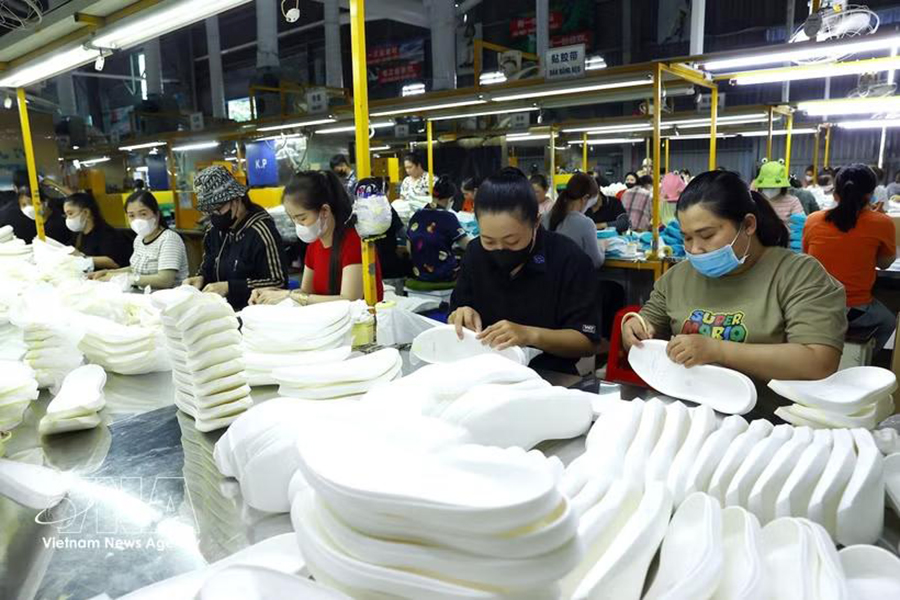
Most vulnerable is the garment, footwear, and travel goods sector, where firms have relied on preferential access, imported inputs, and labour-intensive production.
According to the economists, “if duty-free treatment is reduced while firms still struggle to meet stricter rules of origin, the sector’s cost advantage could erode.
“The transition risk is also broader than tariff preferences: as global trade increasingly incorporates environmental and social compliance requirements, firms will need stronger labour standards, traceability, and supply-chain due diligence to mitigate market-access risks.
“The relevant lesson from past graduates and from Cambodia’s own graduation assessment is that outcomes depend less on graduation itself than on the strength of the production base, institutions, and adjustment capacity during the transition period.”
CAMBODIA HAS ‘REAL STRENGTHS’
Overall, the economists find that Cambodia approaches LDC graduation with “real strengths” — namely sustained foreign investment, deep export integration, and a young workforce.
“These advantages give Cambodia a strong foundation for the transition, but not a guarantee that convergence toward the authorities’ income ambitions will continue.
“LDC graduation raises the stakes: as preferences erode and market access requirements tighten, growth will depend more on domestic capabilities, firm upgrading, and productive employment that raises earnings and supports higher value added.
“The priority is therefore to raise the domestic payoff from investment by developing local suppliers, connecting workers to more productive firms, and reducing the regulatory and infrastructure bottlenecks that prevent firms from scaling.”
The economists conclude that Cambodia “compares well” with many LDC peers on several broad structural indicators.
For example, foreign direct investment (FDI) as a percentage of gross domestic product (GDP) is higher in Cambodia than in Laos and Vietnam. All three are lower middle-income economies.
“The main risks are concentrated in sectors exposed to preference erosion and imported-input dependence.”
By Sao Da