 KH
KH  FR
FR  AR
AR CN
CNICCOS-2026 to Focus on Joint Action to Break Chains of Online Scams
AKP Phnom Penh, September 19, 2026 --
The International Conference on Combating Online Scams (ICCOS-2026) will focus on strengthening international cooperation to address the increasingly complex and cross-border nature of online scams, according to a Cambodian senior official.
H.E. Mok Chansothea, Secretary of State at the Office of the Council of Ministers and Chairman of the Conference Content Sub-Commission, said the conference was initiated to bring together senior officials, law enforcement authorities and experts to better understand the rapid evolution of online scams and explore more effective approaches to combating this transnational crime.
He explained that the conference has three main purposes: to deepen understanding of the changing forms and complexities of online scams, strengthen international cooperation, and provide a platform for countries to exchange practical experiences, including their respective strengths, weaknesses and challenges.
The focus on international cooperation is particularly important because online scams are no longer confined to individual countries. Criminal networks can operate across borders, use different technologies and exploit differences between national legal systems and jurisdictions, making coordinated action increasingly necessary.
These challenges are reflected in the theme of the conference, “Acting Together towards Breaking the Chain and Eradication of Online Scams.” The theme highlights the need for countries to work collectively to disrupt the interconnected networks and activities that enable online scams to operate.
According to H.E. Mok Chansothea, the choice of the theme reflects the increasingly interconnected nature of online scam operations, which involve organised networks, technological tools and cross-border activities. Differences in national laws, legal gaps and limitations of jurisdiction also create challenges that require stronger cooperation among countries.
The theme therefore places emphasis on “acting together” and “breaking the chain” of online scams, rather than addressing individual criminal activities in isolation. It underscores the need for countries to improve information sharing, law enforcement cooperation and coordination among relevant institutions in order to disrupt the networks behind these crimes.
The conference is being supported by the United Nations Office on Drugs and Crime (UNODC) Regional Office for Southeast Asia and the Pacific, INTERPOL, and the Mekong-Lancang Cooperation Security and Law Enforcement Integrated Cooperation Centre. More than 20 countries, including the United States, China, Australia, Japan, the Republic of Korea and ASEAN members, have confirmed their participation.
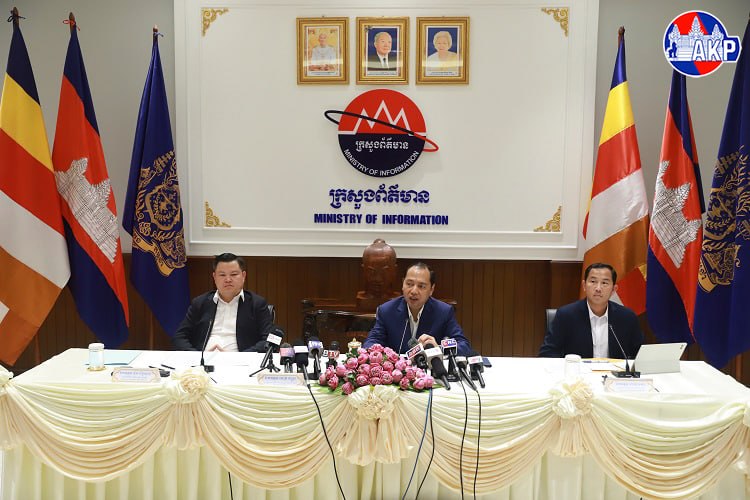
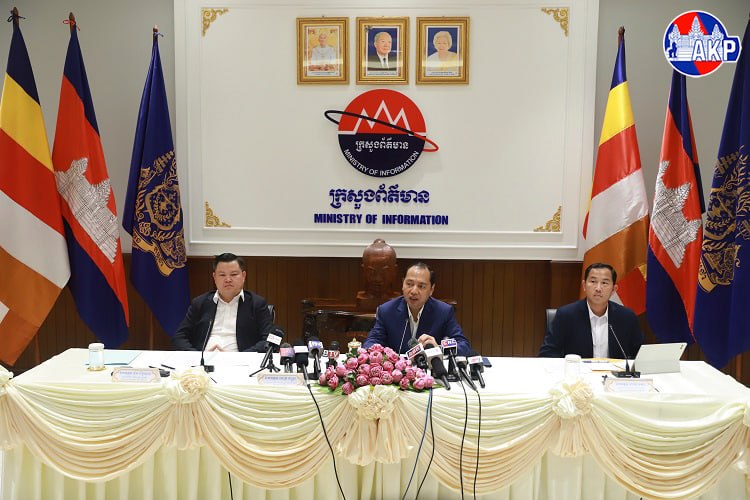
At the same press conference, H.E. Neth Pheaktra, Minister of Information, said the conference provides an opportunity for Cambodia to share its experience in combating online scams and demonstrate its political will, responsibility and openness in addressing the growing threat posed by this crime, he said.
H.E. Minister added that the conference also represents Cambodia’s call for stronger collective action by the international community to combat online scams, which have increasingly become a transnational criminal threat.
According to the Secretariat of the Ad Hoc Commission for Combating Online Scams, from July 2025 through Aug. 31, 2026, Cambodia has frozen more than US$300 million in bank accounts linked to online scam crimes, while 446 cases involving 3,927 suspects have been sent to court.
Authorities have also taken legal action against officials found to be involved in online scam activities. Four cases involving 15 suspects have been handled, including a deputy prosecutor, a deputy director-general of immigration, a deputy Phnom Penh municipal police commissioner, a former director-general of the Ministry of Foreign Affairs, as well as police and military officials.
The report added that specialised law enforcement forces, acting under the Government’s directives, inspected 832 suspected locations and launched crackdown operations at 663 of them.
Among these, authorities cracked down on and took control of 86 major scam compounds, with competent authorities currently undertaking legal procedures for their confiscation in accordance with the law.